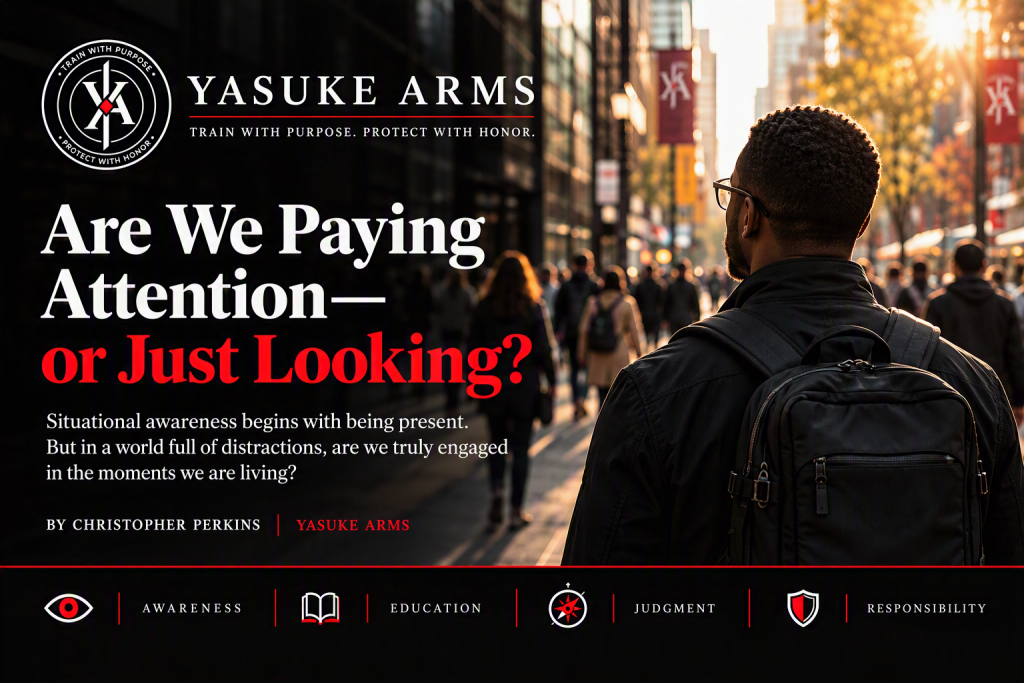
Situational awareness begins with being present. But in a world full of distractions, are we truly engaged in the moments we are living?
We live in a world where our attention is constantly being pulled in different directions.
Our phones demand it. Our responsibilities compete for it. Our routines encourage us to move from one task to the next, often without giving much thought to what is happening around us.
We can be physically present in a room while mentally somewhere else. We can walk through a parking lot, enter a restaurant, or drive through an intersection while our attention is focused on a conversation, a notification, or the next item on our schedule.
We are looking, but are we really seeing?
That question extends beyond personal safety. It touches how we live, how we interact with others, and how we recognize the opportunities and challenges unfolding around us.
The Difference Between Looking and Being Aware
Situational awareness is often discussed in the context of personal protection. Yet its foundation is much simpler: paying attention to our surroundings, recognizing meaningful changes, and making thoughtful decisions based on what we observe.
Awareness is not paranoia. It does not require us to view strangers with suspicion or assume that danger is waiting around every corner.
Instead, it asks us to be observant without being judgmental, attentive without being fearful, and prepared to make decisions without automatically assuming the worst.
There is an important distinction between observing something and deciding what it means.
A person behaving differently from everyone else does not automatically represent a threat. An unexpected sound does not necessarily signal danger. A change in our surroundings may be completely ordinary—or it may deserve closer attention.
The goal is not to invent threats. It is to recognize what is happening before we decide how to respond.
Awareness before action. Judgment before reaction. Responsibility with every choice.
The Cost of Divided Attention
Consider an ordinary moment: walking from a store to your vehicle while concentrating on a phone.
You may reach your destination without incident. Most everyday activities do. But when our attention is divided, we may be less likely to notice changing traffic, someone approaching, an obstacle in our path, or an opportunity to choose a safer route.
The same principle applies beyond physical safety.
During a difficult conversation, are we listening to understand—or simply preparing our response? When a family member speaks, are we present—or are we mentally occupied with tomorrow’s responsibilities? When an opportunity appears, do we recognize it, or are we too distracted to notice?
Attention has consequences. It influences what we notice, what we overlook, and the decisions available to us.
We cannot control every circumstance, and awareness does not guarantee a particular outcome. But we can make a conscious effort to be more attentive to the moments in which we find ourselves.
Are We Focused on Risk—or on Fear?
There is another dimension to this discussion.
Our perception of risk is shaped by personal experience, the people around us, the information we consume, and the events that capture our attention. Dramatic incidents can leave a lasting impression, sometimes making uncommon events feel more likely than they are. Meanwhile, familiar risks may receive less consideration precisely because we encounter them so often.
This can influence how we think about personal protection.
Some people focus on firearms. Others consider knives, personal alarms, flashlights, or other tools. Many prioritize avoidance, communication, physical fitness, medical knowledge, or the ability to recognize and leave an unsafe situation.
These choices are not identical, and the tools are not interchangeable. Each has different capabilities, limitations, responsibilities, and potential consequences.
Nor does the choice to carry a particular tool, by itself, tell us whether someone is responsible, prepared, or dangerous.
The more useful question is whether our approach to personal protection reflects thoughtful judgment—or simply our assumptions about what we should fear.
Are we considering the risks that are relevant to our circumstances? Are we learning how to recognize trouble early, avoid unnecessary confrontation, and make sound decisions under pressure? Are we considering the responsibilities that accompany the tools we choose?
These are questions worth asking regardless of our individual views on self-defense.
Preparedness Begins Before a Crisis
At Yasuke Arms, I believe responsible preparation begins well before a person faces a difficult decision.
It begins with awareness. It develops through education, sound judgment, and continued learning. And it requires an honest understanding of our abilities, our limitations, and the consequences of our choices.
A license, a piece of equipment, or a completed training course can be part of that process. None should be mistaken for a substitute for ongoing responsibility.
Preparedness is not simply about what we possess. It is also about what we understand, what we practice, what we choose to avoid, and how we conduct ourselves when circumstances change.
Sometimes the best decision is to leave. Sometimes it is to create distance, seek assistance, or call emergency services. Different situations require different responses, and good judgment includes recognizing when action is unnecessary or would make matters worse.
The purpose of awareness is not to make us fearful of the world. It is to help us engage with the world more thoughtfully.
A Question Worth Carrying With Us
Perhaps the most important question is not whether we are looking at the world around us, but whether we are truly paying attention to it.
Are we present in our daily lives? Are we recognizing the difference between observation and assumption? Are we evaluating risks thoughtfully, or are we responding to the risks that attract the most attention?
And when it comes to protecting ourselves and the people who depend on us, are we investing in the judgment and education that responsible preparation requires?
We cannot predict every circumstance. We cannot eliminate every risk. But we can choose to become more attentive, more informed, and more deliberate in how we respond.
You cannot be fully prepared for the moments that matter if you are not present for the moments you are living.
That is where awareness begins—not with fear, but with attention.
And perhaps the question we should ask ourselves each day is this:
Are we paying attention to the risks around us—or are we paying attention only to the risks we have been taught to fear?
Christopher Perkins
Yasuke Arms
Train with Purpose. Protect with Honor.