What Every Gun Owner Should Know
Children are naturally curious. They open drawers, climb onto shelves, and explore closets, especially when they think no one is watching. For gun owners, that curiosity is the reason child gun safety starts with the adults in the home.
The good news is that a few consistent habits make a real difference. Here is what every Texas gun owner should know.
Especially when left unsupervised, even for a moment.
1. Lock It Up
The most effective step is also the simplest: when a firearm is not in your direct control, keep it locked.
- Unloaded storage. Firearms not kept for home defense are best stored unloaded and locked, with ammunition stored separately.1. Lock It Up
- Safes and lockboxes. A locked safe or lockbox keeps firearms out of reach. Quick-access safes let you keep a home-defense firearm secured and still reach it when you need it.
- Cable and trigger locks. These make a firearm inoperable while it is locked. They are an inexpensive option, and free cable locks are often available through local law enforcement agencies that participate in Project ChildSafe.
The most effective step is also the simplest: when a firearm is not in your direct control, keep it locked.
2. Control the Keys
A lock works best when only responsible adults can open it. Keys and combinations should be kept where children can’t reach them, and it’s a good idea to change a combination if you think a child may have learned it. Because children are naturally curious, a locked container is a more dependable choice than a hiding spot.
Think beyond the bedroom closet, too: vehicles, bags, nightstands, and guest rooms all deserve the same attention, especially when children visit.
3. Talk About It
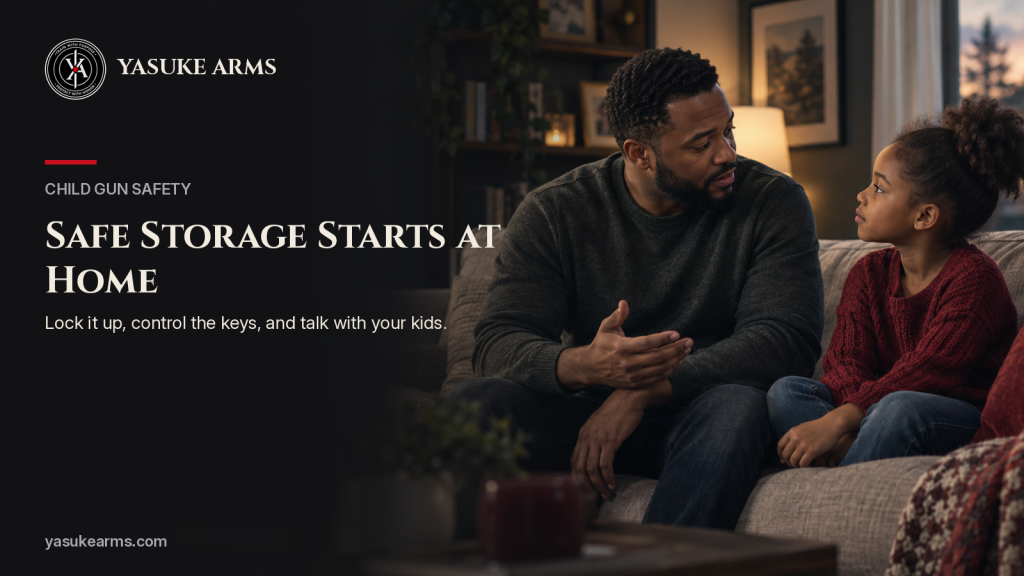
Even in homes without firearms, children may come across a gun at a friend’s or relative’s home. Talk with them early, in calm, simple language they can remember: if you ever see a gun, don’t touch it, leave the area, and tell a trusted adult right away.
NRA’s Eddie Eagle GunSafe® program teaches young children the same idea in four steps: “Stop! Don’t Touch. Run Away. Tell a Grown-up.” The program is designed for children in Pre-K through 4th grade, and no firearms are ever used in it. It offers free resources you can use at home:
- A free, kid-friendly Eddie Eagle video at EddieEagle.com
- Free downloadable activity books for Pre-K & K, 1st & 2nd grade, and 3rd & 4th grade
- Free downloadable parent/instructor guides for each age group
- A printable Wing Team certificate to reward your child for completing the lesson
The downloads are on the Eddie Eagle Program Materials page. Schools, libraries, daycare centers, hospitals, and law enforcement agencies may also receive free program materials.
Repeat the conversation as children grow. A message that works for a five-year-old should become a fuller discussion about responsibility for a teenager.
4. Know What Texas Law Says
Here in Texas the law places the responsibility for secure storage with adults. Texas Penal Code §46.13 addresses keeping firearms secured from children. In general terms:
- A “child” is a person younger than 17.
- The law applies to “readily dischargeable” firearms, meaning firearms loaded with ammunition, whether or not a round is chambered.
- Adults are expected to take reasonable steps to secure a loaded firearm so a child cannot gain access to it, and to avoid leaving it where they know, or should know, a child could reach it.
- The statute describes “securing” a firearm as taking reasonable steps such as placing it in a locked container or temporarily making it inoperable with a trigger lock or other means.
- The statute sets out penalties when these steps aren’t taken, and they are more serious if a child is injured.
The statute also includes certain exceptions, such as supervised hunting or sporting activities. Read the full text, and consult a Texas attorney with any questions about your situation. This section is general information, not legal advice.
Outside Texas? Check the gun laws in your state. Safe storage and child access laws vary from state to state and may differ from the Texas Penal Code.
Free Resources for Texas Families
- Keep ‘Em Safe, Texas offers safe storage checklists and tips: SafeGunStorageTexas.com
- Project ChildSafe (NSSF) provides free safety kits with cable-style gun locks through participating law enforcement agencies: nssf.org/safety/project-childsafe
- Eddie Eagle GunSafe® program (NRA) offers a free kid-friendly video at EddieEagle.com, plus free downloadable activity books and parent guides: Program Materials
How Yasuke Arms Approaches Safe Storage
Safe storage is part of responsible ownership. It is also one of the required topics in the Texas License to Carry classroom curriculum, which covers proper storage practices with an emphasis on eliminating the possibility of accidental injury to a child (Texas DPS). Safe handling and storage are central to how we teach.
Have questions about safe storage or firearm safety training?