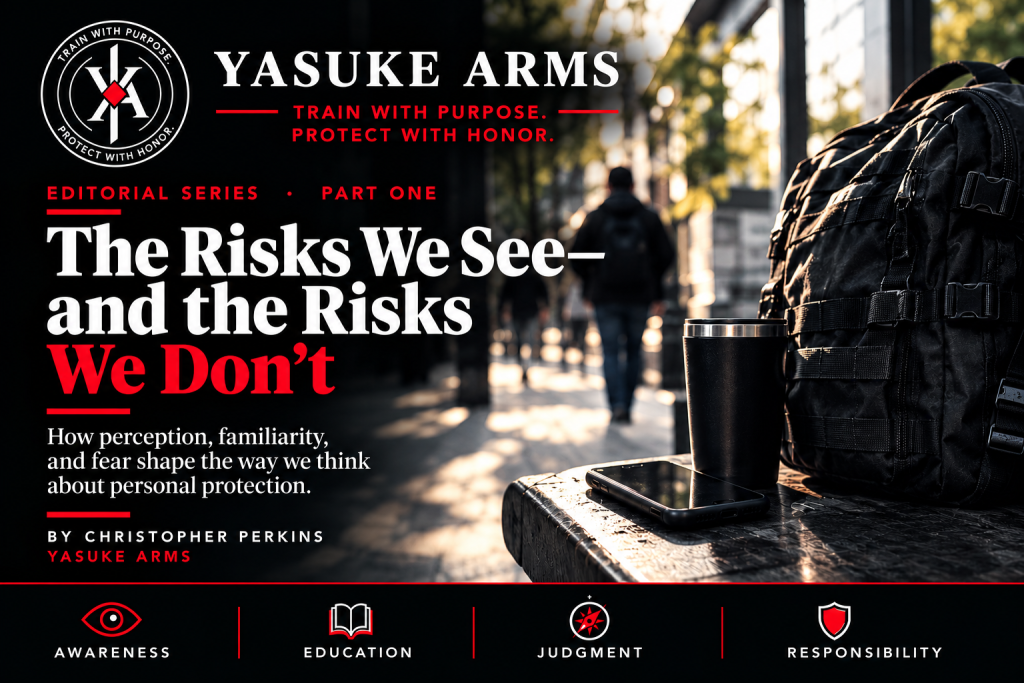
How perception, familiarity, and fear shape the way we think about personal protection.
By Christopher Perkins | Yasuke Arms
We all make decisions about risk.
Some decisions are deliberate. Others are shaped by personal experience, the people we trust, the information we consume, and the routines that make up our daily lives.
We may avoid a particular place because of something we heard. We may feel comfortable in a familiar parking lot because we have visited it hundreds of times. We may worry about a highly publicized crime while giving little thought to risks that are less dramatic but more relevant to our everyday decisions.
These reactions are human. But they raise an important question:
Are we evaluating the risks in our lives—or simply reacting to the risks that have captured our attention?
In our opening editorial, Are We Paying Attention—or Just Looking?, we explored the importance of being present and paying attention to our surroundings.
Now we take the next step. What deserves our attention? How do we distinguish a reasonable concern from an assumption? And how should we evaluate the choices we make to protect ourselves and the people who depend on us?
Recognizing risk matters. Understanding it matters just as much.
The Risks That Capture Our Attention
An unusual or frightening event can leave a lasting impression. News coverage, social media, and conversations with friends can influence how we perceive the world around us. A personal experience can also change how safe—or unsafe—we feel in a particular place.
Fear is not inherently a weakness. It can alert us to a possible problem and encourage us to take sensible precautions.
The difficulty arises when our perception of risk becomes disconnected from the available evidence.
Feeling unsafe does not necessarily establish that a situation is dangerous. Conversely, feeling comfortable does not guarantee that a situation is safe.
Consider two people entering the same public space. One is immediately concerned because of a previous experience. The other feels entirely comfortable because the setting is familiar.
Neither reaction, by itself, tells us everything we need to know about the circumstances.
The more useful approach is to observe what is happening, consider relevant information, recognize uncertainty, and make a proportionate decision.
This is where situational awareness and risk assessment meet. Awareness helps us notice. Judgment helps us interpret. Education helps us distinguish what we know from what we merely assume.
Our feelings can alert us to a question. They should not always be the final answer.
Familiarity Can Create a False Sense of Security
We become comfortable with what we encounter regularly.
We know our route to work. We recognize the entrance to our favorite store. We understand the routines of our neighborhood.
Familiarity is useful. It allows us to navigate everyday life efficiently. But it can also encourage us to stop paying attention.
Imagine walking from a store to your vehicle while concentrating on your phone. You may make that walk hundreds of times without incident. There is no reason to assume that someone nearby has harmful intentions.
Still, you can benefit from noticing moving vehicles, being aware of your surroundings, keeping track of your route, and allowing yourself the time and space to make decisions.
That is the difference between suspicion and awareness.
Suspicion can lead us to assign meaning to someone else’s behavior without sufficient evidence. Awareness asks us to notice what is happening without jumping to conclusions.
We do not need to view strangers as threats to recognize when our attention is divided. Nor do we need to live in fear to take reasonable precautions.
We do not have to assume the worst to avoid overlooking what matters.
What Do the Numbers Actually Tell Us?
Personal protection is often discussed through comparisons: firearms versus knives, one precaution versus another, or one type of risk versus another.
Statistics can help inform these conversations—but only when we understand what they measure and what they leave unanswered.
In an October 2021 Gallup survey, 23% of U.S. adults reported that they carried a gun for defense because of concerns about crime, while 22% reported carrying a knife for defense. The survey also asked about other precautions, including carrying pepper spray and avoiding certain places or neighborhoods.
These are findings about self-reported protective behavior in a particular survey. They do not establish how many Americans carry a knife or firearm every day, how frequently either is used in a defensive encounter, or how effective either tool is in a particular circumstance. The figures should also not be interpreted as current estimates of behavior in 2026. Gallup’s survey and findings.
Now consider a different kind of evidence.
The Centers for Disease Control and Prevention’s National Violent Death Reporting System reported that, among homicides recorded in its 2023 data, firearms were the method of injury in 77.8% of cases, while sharp instruments accounted for 8.7%. These figures describe methods involved in recorded homicides. They are not estimates of how likely an individual is to encounter a firearm or knife, and they do not measure the effectiveness of carrying either for self-defense. CDC, Surveillance for Violent Deaths, 2023.
Both sets of data can contribute to a discussion about risk. Neither answers every question about personal protection.
We must distinguish between how frequently something occurs, how likely we are to encounter it, how severe its consequences may be, and which precautions might reduce the risk.
Those are related questions, but they are not interchangeable.
A statistic can be accurate and still be used to support a conclusion it was never designed to answer.
Evidence should inform our judgment—not be stretched to confirm our assumptions.
Knives, Firearms, and Other Protective Options
Personal protection is not a single decision, and it is not limited to choosing a particular tool.
People approach their safety in different ways. Some prioritize avoiding unnecessary confrontations. Others consider personal alarms, flashlights, communication devices, or other everyday safety measures. Some choose to carry a knife or firearm where lawful. Others focus on training, physical conditioning, medical knowledge, or recognizing when leaving an unsafe situation is the wisest response.
These options serve different purposes. They should not be treated as interchangeable.
A flashlight may help someone see an obstacle or navigate a poorly lit area. A personal alarm may draw attention to a problem. A phone may provide access to emergency services. Knives and firearms have different capabilities, limitations, legal implications, and potential consequences.
The responsible question is not simply, “Which tool is best?”
It is also:
- What circumstances am I preparing for?
- What options might help me avoid or leave a dangerous situation?
- What are the limitations and risks of the option I am considering?
- Do I understand the applicable laws and responsibilities?
- Am I prepared to exercise sound judgment under pressure?
These questions matter regardless of whether someone chooses to carry a protective tool.
Carrying a knife does not, by itself, establish that a person is dangerous. Carrying a firearm does not, by itself, establish that a person is prepared. Neither choice tells us everything we need to know about someone’s intentions, competence, or conduct.
The tool is one part of a much larger picture.
Responsible preparation requires us to consider not only what a tool can do, but also what it cannot do—and the consequences that may follow from choosing to use it.
The Decisions That Come Before a Crisis
There is another dimension to preparedness that can receive less attention than equipment: the decisions we make before a situation becomes dangerous.
Do we notice when a conversation is escalating? Are we willing to disengage from an unnecessary confrontation? Do we recognize when creating distance or moving to a safer location is appropriate? Do we know when to seek help?
Sometimes the best decision is to leave.
Sometimes it is to avoid an argument, move toward a safer area, contact emergency services, or ask for assistance.
These responses may seem ordinary compared with discussions about defensive equipment, but they belong in the same conversation about responsible personal protection.
No approach can eliminate every risk. Awareness does not guarantee that we will recognize every warning sign, and thoughtful decisions cannot control another person’s behavior.
Still, we can improve our preparation by considering our options before we need them.
The goal is not to live in constant anticipation of danger. It is to develop the judgment to respond appropriately when circumstances require it.
Preparedness includes the ability to act when necessary—and the wisdom to recognize when action is unnecessary or could make a situation worse.
From Fear to Informed Judgment
There is a meaningful difference between fearing something and understanding the risk it presents.
Fear may prompt us to ask a question. Education helps us investigate it. Experience can inform our understanding, while reliable evidence helps us test our assumptions.
Together, these can lead to better decisions.
At Yasuke Arms, I believe responsible preparation begins with that process: paying attention, seeking education, understanding limitations, and taking responsibility for our choices.
Preparedness should not depend solely on what we carry or what we fear. It should reflect our ability to assess circumstances, consider alternatives, and make thoughtful decisions.
The most responsible approach is neither to dismiss danger nor to exaggerate it.
It is to remain observant, informed, and willing to reconsider what we believe when better information becomes available.
A Question Worth Considering
We cannot eliminate uncertainty from our lives. We can, however, become more deliberate about how we respond to it.
We can question our assumptions. We can distinguish personal impressions from reliable evidence. We can consider the benefits and limitations of different protective options. And we can recognize that responsible preparation involves far more than owning a particular tool.
So, as we think about personal protection, consider this:
Are we choosing our precautions because we understand the risks—or because we have become accustomed to fearing them?
The answer may influence not only what we choose to carry, but how we pay attention, how we prepare, and how we respond when it matters.
Awareness helps us recognize risk. Responsibility helps us respond to it. Readiness helps us make better decisions.
Yasuke Arms
Train with Purpose. Protect with Honor.